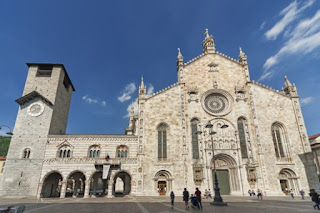
The architecture of the Cathedral represents a joyful case
of harmonization of the different historical periods in which it was built. The
subsequent stylistic phases (Gothic, Renaissance, and Baroque) are mutually
accorded by the wisdom of the architects and the expertise of the workers who labored
there.
On the three Gothic naves, with pointed arches and ribbed
cross vaults, built in the fifteenth century, the three Renaissance apses were
grafted, built between the sixteenth and seventeenth centuries. Thereafter, a
dome was foreseen which, after many unrealized projects, Filippo Juvarra raised
under late baroque drawing.
Just like the Milan Cathedral, the name of the architect who
designed the Gothic factory is not known for that of Como. In fact, the first
attested name is that of an architect from the Intelvi Valley, Lorenzo degli
Spazi, employed by the Fabbrica del Duomo in Milan, who came to Como for
consultancy. It was Pietro da Breggia from Como who oversaw the elevation of
the pylons and the roofing of the vaults. Florio da Bontà (1460-1463) from Como
initially began the construction of the façade. The Milanese Luchino Scarabota
is the architect who completed the rose window and the main spire on the
façade.
To complete the numerous statues on the façade, Tommaso Rodari
da Maroggia from Ticino on Lake Lugano was called in 1484. Three years later,
Rodari was appointed engineer of the factory and continued to produce
sculptures until 1526, the year of his death. With his brothers Giacomo and
Donato, together in his workshop they completed: the sides of the basilica, all
the portals with the lunettes dedicated to the Childhood of Jesus, including
the splendid Porta della frog, the statues of the apostles on the internal
pillars, up to the setting of the main apse on a project modified by Cristoforo
Solari known as the Gobbo who introduced the classical style with fluted
semi-columns of Corinthian and composite order, entablatures and round arches.
Interiors
In the Cathedral there are precious tapestries and
sculptures of different stylistic phases already in the previous basilica: the
Romanesque lions readjusted as a holy water font and the high altar with Gothic
reliefs in white marble from 1317, the sarcophagi of Bishops Avvocati († 1293)
and Bonifacio da Modena († 1352); the Renaissance altars in carved and
originally painted stone, three of which by Tommaso Rodari, the altars of
Sant'Abbondio and the Crucifix of the Pavese carver Giovan Angelo del Maino,
the Baroque altar of the Madonna by Gerolamo Quadrio built around the statue of
Tommaso Rodari; the stuccoes of the apse calotte with the figurative scenes of
the Assumption by Francesco Silva and the Resurrection by Agostino Silva, the
Evangelists by Gaspare Mola di Coldrerio in the spandrels of the dome, the
neoclassical sculptures by Pompeo Marchesi (central apse and altar of St.
Joseph).

Among the painters of the sixteenth century, Bernardino
Luini, Gaudenzio Ferrari, Antonio Sacchiense from Pordenone, and Morazzone from
the seventeenth century stand out. Remarkable are decorations of the vaults by Carlo
Fontana and Francesco Gabetta (1839) and the stained glass windows by the
Bertinis (19th century).
Organs
The oldest evidence on the organ of the Como Cathedral dates
back to 1441. The ancient instrument was the subject of various adaptations and
repairs in the 16th century, until the Antegnati, masters of Renaissance and
Baroque organ-making, intervened. Costanzo Antegnati attributes the
construction of the organ "which is still played at present" (1608)
to the ancestor Bartolomeo.
From 1625 to 1642 the chest of the left aisle was built, in
the structure that we still see today. In it Giovan Battista Olgiati arranged,
in 1647, the reeds, bellows and wind chests of the instrument already present
in the Cathedral.
In 1649 the structures of the right case were also completed,
where a new organ was installed, created by the Jesuit William Hermans,
consisting of two superimposed sound bodies: the Large Organ with 14 stops and
the Small Organ with 8 registers. The inauguration of this work took place on
25 March 1650, the feast of the Annunciation.
The Cathedral of Como thus possessed two instruments placed
in two different cases: the “Maggiore” or southern one and the “Minor” or
northern one. Restorations and revisions followed in the history of the
following centuries: in 1808 Hermans’ organ was renovated by Giuseppe Antonio
and Carlino Serassi; in 1862 Antonio De Simoni carried out a general cleaning
and some additions to Hermans’ organ. At that time, the organ of the Duomo had
three keyboards, 56 registers and a pedal board with less than 20 keys.
In 1887 Marco Enrico Bossi, organist and teacher of the
Chapel, promoted a radical makeover of all the sound bodies of the Cathedral:
the "Major" organ was placed in the right case, built from three
bodies for a total of 55 registers and over 3000 pipes; the "Minor"
organ with 24 registers and 1067 pipes was placed in the left case.
The
inauguration of the new complex took place on May 26, 1888. The current organ complex was built by the Balbiani Vegezzi
Bossi house in Milan in 1932, consisting of 58 sound registers for 5460 pipes.
The "Grand Organ" is placed in the old chest on the left; the
“Positivo” and “Recitativo” (expressive) organs are in the right case. The "Eco"
organ is located in the "Carpano" room above the left sacristy.
In 1934, a "Choral" organ was added (9 registers
and 933 pipes) placed in the center of the choir stalls in the main apse and
from here transferred, in 1981, behind the altar of the Crucifix, to the left
apse.
The restoration that ended with the inauguration on 12 May
1998 was carried out by the Mascioni organ building, a Varese house with an
ancient and glorious artistic tradition, which had already worked in the Como
cathedral in 1928.
Latest interventions have expanded the ensemble with a
further 122 pipes that correspond to two reed registers: the
"Cromorno" of 8 'in the "Choral" organ and the
"Chiarina" of 4' in the "Grand Organ".
Therefore today the instruments of the Cathedral have 69
sound registers and 6515 pipes.
In parallel with the cleaning of the left transept, the
"Choral" organ was overhauled in 2015. Thanks to the donation of an
anonymous benefactor, the original console with three keyboards (1932) has been
restored, put back into operation and placed in the left apse while the modern
"console" with four keyboards (1986) is now placed in the nave, in
proximity of the pillar that supports the wooden balcony of the
"Grand'Organo".
Visits to the Como Cathedral can be performed anytime
between 8am and 19pm Monday through Friday. It is always possible to take
photographs (as long as it is for personal use and not for commercial purposes)
with the exception of moments when Mass is celebrated. If you are looking
forward to participating in sacraments and liturgy, consult the official
website www.cattedraledicomo.it/en/home-2 for more information.


 Getting to the Mercanteinfiera Spring 2022 fair takes just an hour or so from Milan, Bologna, and Verona by car through the motorway exit (A1). Florence, Padua, Turin, and Genoa a little more. The Parma ring road allows participants to quickly reach every point of the city. In this way, the Parma exhibition center can also be reached quickly from the spa towns of Salsomaggiore and Tabiano. The complex also has over 9,000 parking spaces and the daily fee will be about $8.