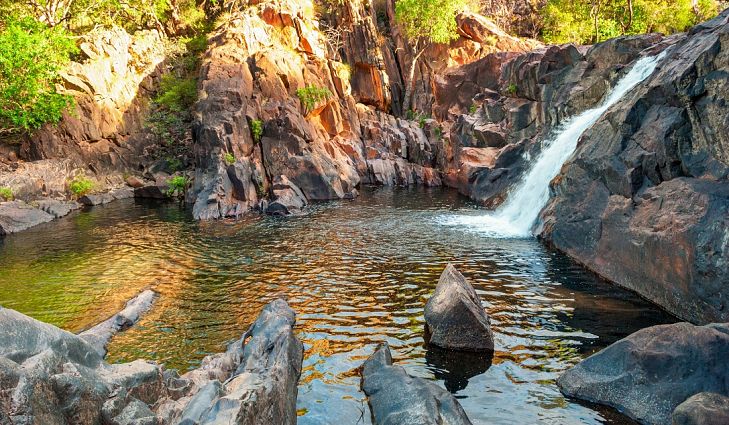
Even
when winter dominates the southern hemisphere this time of the year, Australia
is a favorite destination all through the four seasons. The north of the
country attains higher temperatures while the south copes with wintery days.
One of the places, where you can travel to and still experience summer weather
is Darwin.
The
capital of Australia's Northern Territory and a former frontier outpost, Darwin
is also a gateway to the massive Kakadu National Park. Its popular waterfront
area has several beaches and green areas like Bicentennial Park. Furthermore, near
the water stands the Museum and Art Gallery of the Northern Territory,
displaying Southeast Asian and Pacific art, plus a pearling lugger and other
seafaring vessels.
If
you fly out of North America, the carriers that can take you to Darwin connecting
in Sydney are American Airlines, Quantas, and Emirates. On average, the
temperature has been 74 degrees during the last ten days. If you decide to stay
in the city area, your accommodation options are great. Their rates fluctuate
between $55 and $187 near the oceanfront.
Once
you are good with your hotel reservations, your next step is to get around. A
taxi can take you to downtown for about $25 or $30 in case that you are
undecided about starting with a car rental. Be aware that a $4 toll has to be
paid by you and not by the driver once you exit the airport, though.
 |
| Lake Alexander |
If
you want to start driving all over from the airport, the car rental counters
are located at the Arrivals Hall near baggage collection on the ground floor.
Darwin City Airport Shuttle Service provides a convenient and reliable service
to and from the terminals and all city accommodation locations. The service
operates from the terminal doorstep.
 |
| Kakadu National Park |
Whoever
said you can’t swim in Darwin couldn’t have been more wrong. On top of four
public swimming pools and four dry-season patrolled beaches within 15 minutes
of the CBD, Darwin and the surrounding area offers plenty of excellent – and
some quite unique – swimming opportunities.
 |
| Crocosaurus Cove |
Start
at the chic Darwin Waterfront, where you can grab a boogie board and ride the
swell in the Wave Pool or hit the man-made beach at the Recreation Lagoon,
where nets protect swimmers from marine stingers.
Families
should make a beeline for Lake Alexander in the beautiful East Point Reserve.
Filled with filtered seawater, the lake provides safe swimming in natural
surroundings with picnic areas and playgrounds.
 |
| Litchfield National Park |
Kids
of all ages love splashing about at Leanyer or Palmerston Water Parks, with
huge waterslides, swimming pools and fantastic water playground with fountains,
canons and a huge bucket that slowly fills and douses the playground when it
overflows.
Pack
your bathers when you visit Crocosaurus Cove in Darwin city. After learning all
about crocodiles above water level you can eyeball one below it in the famous Cage
of Death, a Perspex box that’s lowered into the monstrous reptile’s pool.
 |
| Wagai Beach |
Pack
a picnic or some meat to barbecue and head to Berry Springs Nature Park, a
hugely popular day trip an hour from Darwin. Swim from one pool to the next via
a pretty pandanus-lined creek and take your goggles to spot small fish and
other aquatic life that live in the clear pools.
Spend
a day experiencing this region’s best-known natural swimming pools at
Litchfield National Park, an hour and a half from Darwin. Glide through the
clear pools of Wangi and Florence Falls to thundering double waterfalls, soak
in the tired cascades at Buley Rockhole or jump in a four-wheel drive to
experience the lesser-known Tjaynera Falls (Sandy Creek).
 |
| Berry Springs |
Wagait
Beach is a locality approximately 8 km west of Darwin, on the opposite side of
the harbor. It makes up the Wagait Shire local government area. Wagait
Beach is not part of Darwin, but many of its residents use the Mandorah ferry
to travel to work in Darwin. Wagait Beach is on the north coast of the Cox
Peninsula, which forms the western side of Darwin Harbour. It is part of the
Hundred of Bray, as surveyed by George Goyder in 1869-70. "Wagait"
(also spelled "Waugite") is a local Aboriginal language word meaning
beach or salt water country.
Bring
lots of sun block lotion to protect yourself and family or friends. Winter in
Darwin, Australia, might invade you with tons of sun rays.


 Federico Cuco is the owner of Verne Cocktail Club, which is named after the author Jules Verne. He is a veteran bartender and an amateur cocktail historian. Mr. Cuco can serve you one of his house originals, such as the smoky Opium Old-Fashioned, or he can tell you about Buenos Aires’ rich mixological history, which includes mid-20th-century bartender celebrities like Santiago Policastro (1912-2010). Famous for his nickname “Pichin,” Policastro cut a big enough figure to appear on television and publish a book, “Tragos Magicos” (or “Magical Drinks”). Mr. Cuco was behind a campaign a decade and a half ago to “Save the Clarito,” the Clarito being a forgotten dry Martini riff by Pichin. It worked. You can order a Clarito anywhere in the city now. (The chief difference between the original Clarito and a Martini was a sugar rim. That touch, gratefully, has since been dropped.)If you ask for other historical Buenos Aires cocktails, there’s a good chance Mr. Cuco will know how to prepare them. Likewise, he is a committed advocate of local heritage brands like Amargo Obrero, a mild regional amaro, and Hesperidina, an orange liqueur that, in 1876, became Argentina’s first patented product. Oddly enough, Hesperidina was created by Melville Sewell Bagley, an immigrant from Maine.
 Floreria Atlantico is Buenos Aires’ most famous cocktail bar, a reputation it may have secured solely through the energies of its owner, Renato Giovannoni, a charismatic man who knows how to fill up a room. He also knows how to paint up a room; the pictures of sea monsters on the walls are his creations. Mr. Giovannoni describes his bar as being a tribute to the multi ethnic history of the city’s population. Fittingly, the menu is divided by national influence, with sections dedicated to Spain (sherry drinks), Poland (vodka) and England (gin, Scotch). The bar’s signature drink is, naturally, a Negroni variation, but the dizzyingly complex Balestrini Negroni tells a distinctly Argentinian story. The Campari is locally distilled. The gin, Principe de los Apóstoles, comes from Mr. Giovannoni's personal palate, boasting botanical specimens such as yerba mate (a South American herbal tea) and eucalyptus. Averna amaro replaces the usual vermouth. A dash of seawater from the actual Atlantic Ocean provides a saline accent. (The bar is called Atlantico, after all.) This is all infused with eucalyptus smoke and garnished with pine nuts. The eucalyptus branches could conceivably have been fetched from the flower shop upstairs, which serves as a false front for the bar.
 It is evident that money finds a sophisticated way into the Buenos Aires bar scene upon entering the chic Presidente, which opened a couple of years ago. The Presidente is extravagantly appointed, with chandeliers, high ceilings, a library-like private bar in the back and staff members who look like models. On the wall, there is a painting that portrays 19th-century American bartender Harry Johnson, who seems to be the bar’s spiritual guide, according to some folks. A LED counter above the bar tracks the number of Negronis sold. It’s a trick borrowed from Dry Martini, a Barcelona bar that depicts this count in a similar format. Certainly, you might choose the Milano Torino instead, a gin-less predecessor of the Negroni, which is just as good. And the Buenos Aires Zombie makes an impression, arriving in a tall, white, custom tiki mug meant to resemble the Obelisco de Buenos Aires, an inescapable city landmark.
 Buenos Aires’ longstanding aperitif tradition extends to vermouth. Cinzano, the Italian vermouth company, has been a big presence here since the late 1800s; Argentina is, in fact, the top consumer of Cinzano in the world. La Fuerza — which was opened by Julián Díaz, a prominent local bar owner, the writer Martín Auzmendi and two partners, occupying a bright, cheery corner storefront — offers a traditional, yet fresh approach to the aperitif ritual. It is a vermouth bar, or vermutería, a sort of bar that was once common in Argentina, but is now scarce. La Fuerza sets itself apart in that makes its own vermouth, using wines distilled in Mendoza and flavored with botanical specimens handpicked around the Andes foothills. The owners tout it as the first vermouth to ever be produced in the Andean region. There’s a rojo and a bianco and both are on tap. Try them by themselves over ice with a twist; or, as porteños sometimes do, pair the rojo with fernet, and the bianco with Campari. The concise food menu has everything you’d ever want to nibble on while sipping a vermouth, including various olives, an assortment of cheese, fries, local salame from Tandil, lupin beans and pallares, which are like lima beans.